DSTA4D: Content-aware Adaptive Decoupling for 4D Point Cloud Video Understanding
DSTA4D: Content-aware Adaptive Decoupling for 4D Point Cloud Video Understanding
Pattern Recognition 2026Pattern Recognition 2026
理解四维点云视频对于智能体感知外部环境中的动态变化至关重要。然而,由于长序列点云固有的帧间时间不一致性与空间无序性,构建统一的四维全局建模方法仍面临显著挑战。现有方法主要依赖静态、单一的网络架构,对所有输入数据采用统一的计算流程。这种方式忽视了不同视频在时空复杂度上的差异,导致计算资源分配效率较低,并限制了模型性能。
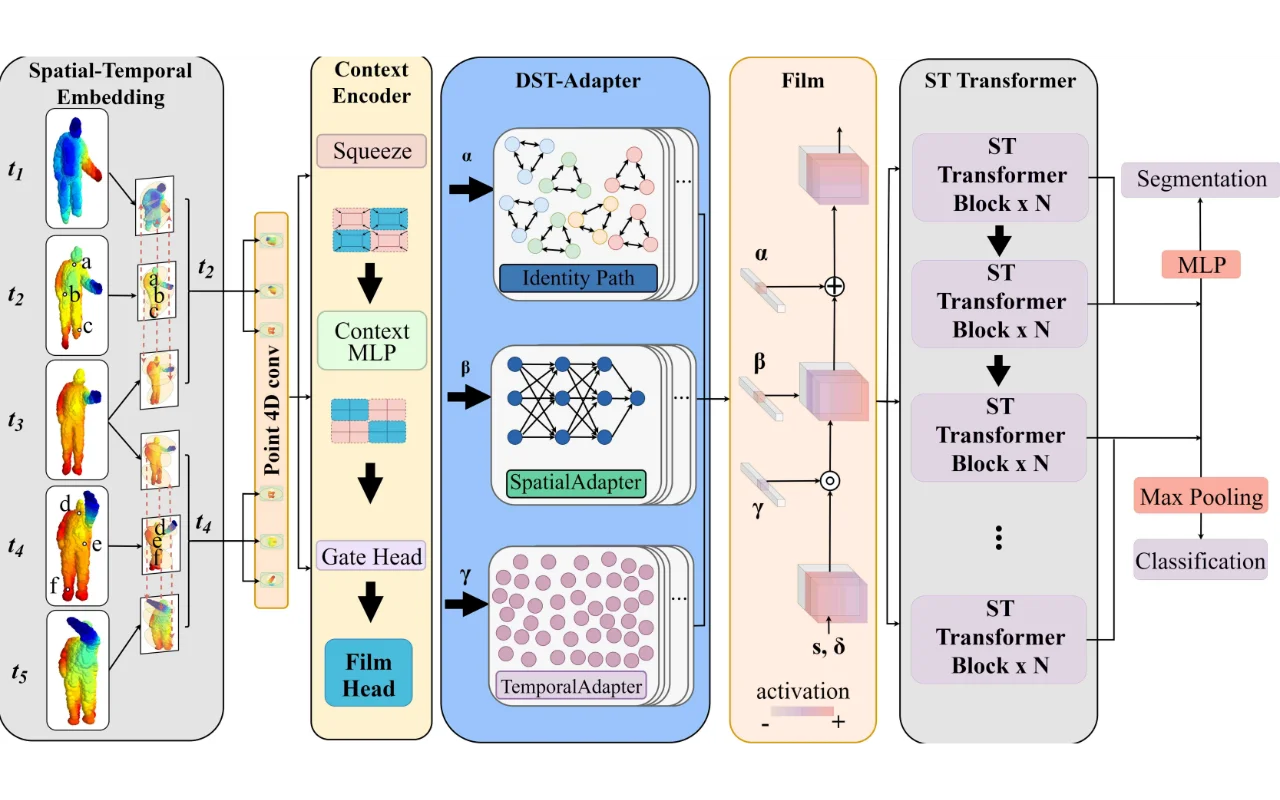
为解决上述问题,我们提出了一种新颖的内容感知四维点云处理方法 DSTA4D,通过自适应模块实现动态时空解耦。首先,我们在嵌入层中对时间特征与空间特征进行解耦,从而避免在整个网络过程中进行复杂的长时序联合建模。其次,我们提出了一种创新的轻量级模块——动态时空适配器(Dynamic Spatio-Temporal Adapter, DST-Adapter)。该模块根据输入序列的全局时空特征动态生成门控权重,并自适应融合来自三条并行分支的特征,包括恒等映射分支、空间增强分支和时间增强分支。
这种内容感知机制使模型能够根据输入数据的特点,智能地将计算重点分配至最关键的特征维度。我们在多个主流基准数据集上的实验表明,该方法取得了显著的性能提升。这些结果表明,DSTA4D 为四维点云视频理解提供了一种更加高效、智能且具有自适应能力的建模范式。
Understanding 4D point cloud videos is crucial for intelligent agents to perceive the dynamic changes in their external environment. However, due to the inter-frame time inconsistency and spatial disorder inherent in long-sequence point clouds, designing a unified 4D global model faces significant challenges. Existing methods primarily rely on static, monolithic network architectures that apply a uniform computational pipeline to all input data. This approach neglects the differences in spatio-temporal complexity across videos, resulting in inefficient resource allocation and limiting model’s performance. To address these issues, we present a novel content-aware 4D point cloud processing approach, termed DSTA4D, which leverages dynamic spatio-temporal decoupling via adaptive modules. We first propose decoupling temporal and spatial features within the embedding layer, which avoids the complexity of full-process long-term modeling. Second, we introduce a innovative lightweight module: Dynamic Spatio-Temporal Adapter (DST-Adapter). This module dynamically generates gating weights based on the global spatio-temporal features of the input sequence and adaptively fuses features from three parallel streams: identity path, spatial enhancement path, and temporal enhancement path. This content-aware mechanism allows the model to intelligently allocate its computational focus to the most critical feature dimensions. Our experiments on mainstream benchmarks show significant performance gains, offering a more efficient and intelligent adaptive modeling paradigm for point cloud video understanding.