Map as a Prompt: Learning Multi-Modal Spatial-Signal Foundation Models for Cross-scenario Wireless Localization
Map as a Prompt: Learning Multi-Modal Spatial-Signal Foundation Models for Cross-scenario Wireless Localization
ICLR 2026ICLR 2026
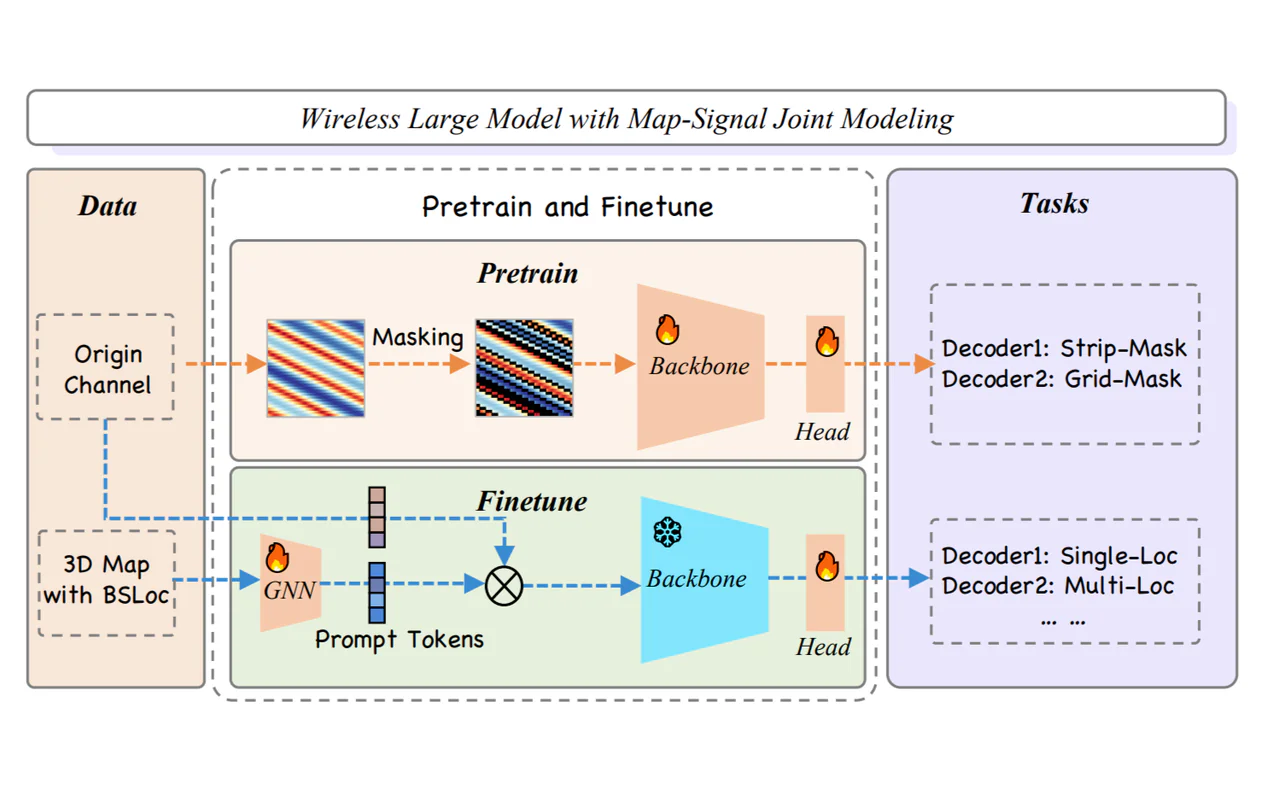
精准、稳健的无线定位是自动驾驶、扩展现实和智能制造等 5G/6G 应用的重要基础,但无线信号复杂且易受环境变化影响。已有数据驱动方法往往依赖大量标注数据,在跨环境迁移时也面临泛化能力不足的问题。
为解决这些问题,论文提出多模态无线定位基础模型 SigMap。该模型根据无线信道的周期特征动态调整掩码模式,以学习稳健的信号表示;同时提出“地图即提示”机制,通过轻量级软提示融入三维地理信息,从而高效适应不同定位场景。
多项定位任务的实验表明,SigMap 在监督和自监督基线之上取得了更好的定位性能,并在未见环境中展现出较强的零样本泛化能力。
Accurate and robust wireless localization is an important enabler for emerging 5G/6G applications, yet the complexity of wireless signals and their sensitivity to environmental changes make cross-scenario localization difficult. Existing data-driven methods often require extensive labeled data and generalize poorly to new environments.
The paper proposes SigMap, a multimodal foundation model for wireless localization. Its cycle-adaptive masking strategy changes the masking pattern according to channel periodicity to learn robust signal representations. A map-as-prompt mechanism then incorporates 3D geographic information through lightweight soft prompts for efficient adaptation across scenarios.
Experiments across multiple localization tasks show state-of-the-art performance and strong zero-shot generalization in unseen environments compared with supervised and self-supervised baselines.