面向自主式交通指挥与管控的多模态具身智能关键技术研发
Key Technologies for Multimodal Embodied Intelligence in Autonomous Traffic Command and Control
深圳市科技创新局重点产业研发项目Shenzhen Science and Technology Innovation Bureau Key Industry R&D Project
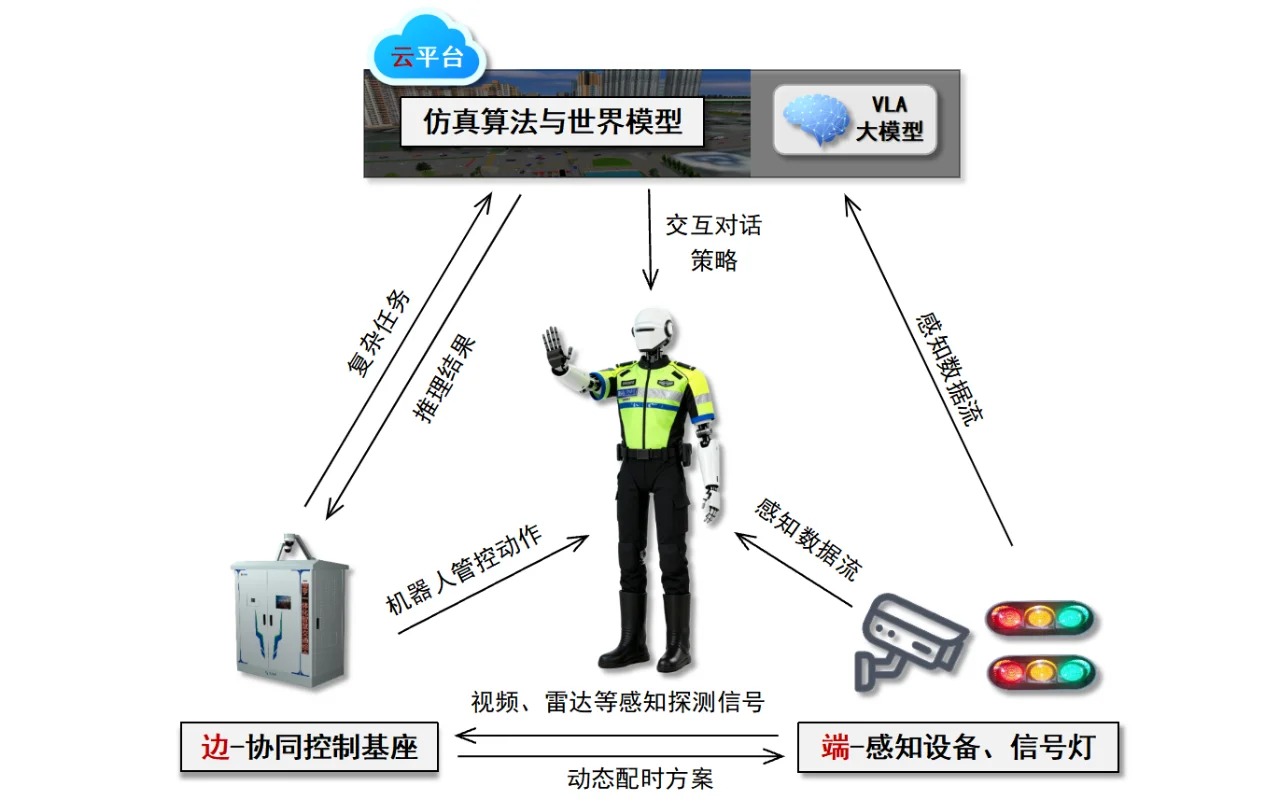
当前,包括深圳在内的国内城市交通系统管控表现出以下突出问题:超大型城市传统交通指挥与管控效率较低,智能化水平亟需增强;一线管控警力相对紧缺;城市拥堵疏解能力有限,交通系统韧性仍显不足。当前的交通系统亟需向具有智能化决策、无人化指挥、快速实时响应能力的自主式系统演进,满足未来智慧城市发展的迫切需求。
在这一背景下,本研究旨在实现以机器人智能体为核心的智能化、自主式交通指挥与风险管控的新型系统。为实现本项目的研究目标,必须解决“指挥决策不可靠”,“人机交互不灵活”,“仿真推演不精确”,“设施系统不完善”四大关键现有技术难题。
针对这四大问题,本项目设置了五大研究内容,从多模态大模型构建、人机交互策略,到虚实互馈建模、云边端协同控制,最后落脚到应用示范,最终将构建一个以机器人智能体为核心,由观测感知与路边控制基座设备及云端大模型和推演仿真算法共同支撑的智能化系统。
Urban transportation systems in China, including those in Shenzhen, currently face several prominent challenges. Traditional traffic command and control systems in megacities remain relatively inefficient and require a higher level of intelligence. Frontline traffic-control personnel are in relatively short supply, while the capacity for congestion mitigation remains limited and the resilience of urban transportation systems still needs to be strengthened. There is therefore an urgent need for transportation systems to evolve toward autonomous systems capable of intelligent decision-making, unmanned command and control, and rapid real-time response, in order to meet the future demands of smart city development.
Against this background, this research aims to develop a new intelligent and autonomous system for traffic command and risk management, with robotic agents at its core. Achieving this goal requires addressing four key technical challenges in existing systems: unreliable command and decision-making, inflexible human–robot interaction, inaccurate simulation and scenario evaluation, and inadequate supporting infrastructure.
To address these challenges, the project is organized around five major research directions, covering multimodal large-model development, human–robot interaction strategies, virtual–physical closed-loop modeling, cloud–edge–device collaborative control, and application demonstration. Ultimately, the project will establish an intelligent transportation system centered on robotic agents, supported jointly by sensing and observation capabilities, roadside control and infrastructure devices, as well as cloud-based large models and simulation-based decision-support algorithms.